
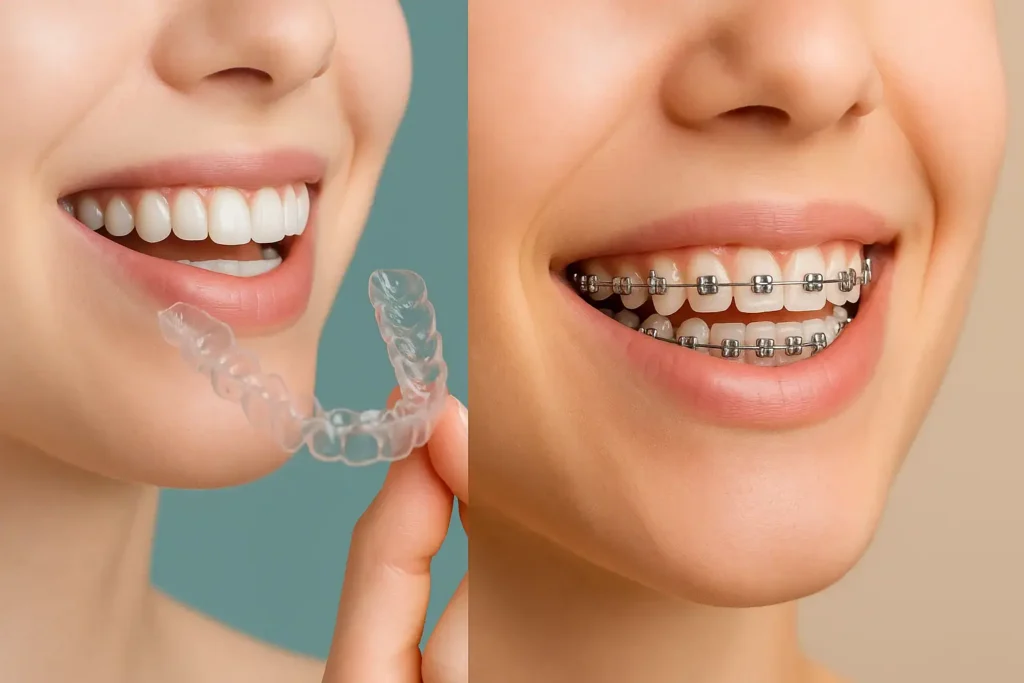
You want straighter teeth, and now you are stuck between clear aligners and metal brackets. Both work. The hard part is knowing which one fits your life.
For most people in Wenatchee, Invisalign and braces cost about the same and reach a similar result. Invisalign runs roughly $3,000 to $8,000 and braces $3,000 to $7,000 in Washington in 2026. The real choice comes down to your case, your daily discipline, and how visible you want treatment to be, not the price tag.
Dr. Douglas Milner, DDS, offers Invisalign treatment in Wenatchee. He is an accredited member of the American Academy of Cosmetic Dentistry, so his focus is the finished smile, not just moving teeth. At a consultation he checks your bite and tells you which option suits your case, and he will say plainly if your case is better handled by a specialist.
What to weigh before you choose
- In Washington in 2026, Invisalign runs about $3,000 to $8,000 and braces about $3,000 to $7,000, so cost is rarely the deciding factor.
- Invisalign suits mild to moderate cases, while braces handle complex crowding and bite problems more predictably.
- Invisalign needs 20 to 22 hours of daily wear, while braces work on their own once they are on.
- Adults finish Invisalign in about 12 to 18 months and braces in about 18 months to 3 years.
- Ask for a consultation at Fibonacci Smile to see which option fits your teeth and your budget.
Invisalign: how it works and who it fits
Invisalign straightens teeth with a series of clear, removable trays instead of brackets. You switch to a new tray about every one to two weeks, and each one nudges your teeth a little closer to the goal. It works best for mild to moderate crowding, spacing, and minor bite issues. It also asks for real discipline, since you wear the trays 20 to 22 hours a day.
The draw is that almost nobody notices them. You take the trays out to eat, brush, and floss, so your daily routine barely changes. That makes Invisalign popular with adults who talk to people all day and would rather skip a mouth full of metal.
The catch is on you. Trays only move teeth while they sit in your mouth. Leave them out for long lunches and late nights, and progress stalls. Align Technology, the maker of Invisalign, reports that aligner patients average fewer office visits than braces patients, partly because there are no brackets to break.
Are traditional braces still worth it?
Yes, especially for harder cases. Traditional braces use metal or ceramic brackets bonded to each tooth, linked by a wire the dentist adjusts over time. Since braces stay put, they apply steady pressure with no daily effort from you. For severe crowding, wide gaps, or a serious bite problem, braces often give more predictable control than aligners.
Braces have one built-in advantage: you cannot forget to wear them. That removes the discipline problem that slows some Invisalign cases. For kids and teens who might lose trays, that alone can settle the decision. It also helps for anyone with a packed schedule who does not want one more daily habit to track.
The trade-offs are visibility and upkeep. Brackets and wires show, though ceramic ones blend in more and cost a little extra. You also clean around them and skip hard or sticky foods that can pop a bracket. The American Association of Orthodontists suggests a first orthodontic check by age 7, which helps catch bite problems early whichever route a patient takes later.
Invisalign vs braces at a glance
Here is how the two options compare on the things patients ask about most.
| Factor | Invisalign | Traditional braces |
|---|---|---|
| Look | Clear, removable trays | Metal or ceramic brackets and wires |
| Best for | Mild to moderate cases | Moderate to complex cases |
| Typical cost, WA 2026 | $3,000 to $8,000 | $3,000 to $7,000 |
| Treatment time, adults | About 12 to 18 months | About 18 months to 3 years |
| Daily wear | 20 to 22 hours, remove to eat | Fixed, always on |
| Eating | Remove trays, eat anything | Avoid hard or sticky foods |
| Cleaning | Brush and floss normally | Work around brackets |
| Discipline needed | High | Low |
| Retainer after | Yes, $400 to $800 | Yes, $400 to $800 |
What does each cost in Wenatchee?
In Washington in 2026, Invisalign generally costs $3,000 to $8,000 and traditional braces $3,000 to $7,000. Around Wenatchee, most straightforward cases land in the middle of those ranges. The national price gap between the two has shrunk to about $175 for similar cases, so your bite and treatment length matter far more than the method.
What moves the number is complexity. A few months of minor straightening costs a fraction of a full 18-month plan. Ceramic braces can actually run higher than Invisalign, so clear does not always mean cheaper.
Many dental plans treat Invisalign and braces the same, covering about half of orthodontic care up to a lifetime maximum near $1,500 to $2,500. That benefit often applies whether you pick trays or brackets, and coverage for children is usually stronger than for adults. Retainers after treatment add $400 to $800, and they are not optional if you want the result to hold.
Fibonacci Smile offers CareCredit financing that spreads either treatment into monthly payments. Paying in full by cash or check earns a 5 percent discount. Ask the front desk to check your orthodontic benefit before you decide. A $5,000 plan split over 24 months lands near $200 a month, and less if insurance covers part of it.
Which is more comfortable to live with?
Most people find Invisalign easier day to day. The trays have no sharp edges, and you take them out to eat whatever you want. Braces can rub the inside of your cheeks at first and need care around the wires. Both cause some soreness when teeth start moving, usually for a day or two after each new tray or adjustment.
Comfort is not only about the mouth. It is about your routine. With Invisalign you brush and floss normally, which keeps cleaning simple. With braces you work around brackets, so hygiene takes longer and matters more, since trapped food can lead to decay.
For some people, though, removable is the downside. If you know you will leave the trays out, the fixed nature of braces is the more comfortable choice in the end, because you are not fighting your own habits.
One more thing to expect early on. New Invisalign trays can give you a slight lisp for a day or two while your tongue adjusts, and fresh braces can leave you eating soft foods for a few days after they go on. Both settle quickly. Neither should hurt beyond mild pressure, and over-the-counter pain relief handles the first day if you need it.
Treatment time, side by side
Adults usually finish Invisalign in about 12 to 18 months and braces in about 18 months to 3 years. Simple cases can be much faster, and complex ones run longer either way. Invisalign only moves teeth while you wear the trays, so missed hours stretch the timeline. Braces keep a steadier pace because they never come off.
For straightforward cases, the two are closer than people expect. Research in the American Journal of Orthodontics and Dentofacial Orthopedics found that aligners and braces reached similar results for simple cases, with comparable stability afterward. How closely you follow the plan matters more than the appliance itself.
Two things quietly extend a timeline. With Invisalign, refinement trays at the end fine-tune small movements and can add a few weeks. With braces, a broken bracket or a missed adjustment visit sets the schedule back. Keeping your appointments is the simplest way to finish on time with either one.
How do you choose between them?
Start with three questions. How complex is your bite? How disciplined are you? How much does visibility matter? A mild case, strong discipline, and a wish to stay discreet point to Invisalign. A complex bite, or a worry that you will not wear trays, points to braces. A dentist’s exam settles it.
The honest answer is that a website chart cannot make this call. Two people with the same crooked front tooth can need different plans once a dentist checks the roots and bite. A college student with mild crowding who never misses a step is a strong Invisalign candidate. A busy parent correcting a deep overbite may do better with braces that work without a second thought. That is why every good quote starts with an exam, not an average.
This is also where the finished look comes in. An accredited cosmetic dentist thinks about how the smile frames your face, not only whether the teeth line up. You can talk through both orthodontic options and your cosmetic goals in one visit.
Getting a straight-teeth plan in Wenatchee
The one way to know your real cost, timeline, and best option is a consultation. The dentist scans your teeth, checks your bite, and lays out both paths with honest numbers for your case. That turns a broad range into one plan you can actually decide on.
If the choice has kept you stuck, a short visit clears it up fast. Bring any recent dental records and a rough sense of your timeline and budget, and the plan comes together quickly. Our Wenatchee dentist sees both teens and adults for this. Book a consultation with Dr. Milner at Fibonacci Smile, 1 Fifth Street, Suite 100 in Wenatchee, and you will leave knowing whether Invisalign or braces fits your smile and your budget. Call (509) 665-0300 to set it up.