
Porcelain Crowns in Wenatchee, WA
A dental crown covers the entire visible surface of a tooth, from the biting edge down to the gumline. It is used when a tooth is too damaged, decayed, or structurally compromised for a filling or onlay to hold reliably. When done well, a crown should be indistinguishable from the teeth surrounding it.
Dr. Douglas Milner, DDS has been placing crowns in the Wenatchee Valley since 1994. He holds Accreditation from the American Academy of Cosmetic Dentistry, which means the aesthetic standards he applies to cosmetic work, shade matching, proportion, translucency, carry into every crown he places. A crown on a back molar matters less visually than one on a front tooth, but every crown Dr. Milner places is treated as something the patient will have in their mouth for the next decade or two.
Fibonacci Smile uses CEREC technology to design and mill crowns in-office. In most cases, that means you leave with a finished permanent crown at the same appointment as your tooth preparation. Call (509) 665-0300 to schedule, or read on to understand what crowns involve and whether you need one.

Schedule Your Crown Consultation
When Is a Crown Actually Necessary?
Dentists and patients sometimes disagree about when a crown is the right call versus a filling or a different restoration. Here is an honest framework for when a crown is the appropriate choice versus when a less invasive option may serve better.
When a Crown Is the Right Answer
- A tooth has decay or fracture so extensive that a filling would leave insufficient natural tooth structure to hold it reliably
- A tooth has had a root canal treatment, particularly a molar — root canal therapy removes the pulp and leaves the tooth more brittle; an uncrowned molar after a root canal has a significantly elevated fracture risk
- A cracked tooth where the crack extends toward the root — a crown holds the tooth together and prevents the crack from propagating
- A tooth is severely worn from grinding or acid erosion
- An existing large filling has failed and there is not enough remaining tooth structure to support another filling
- An implant post needs a crown restoration placed on top
- Cosmetic rehabilitation of a tooth that is severely discoloured, misshapen, or structurally compromised beyond what veneers can address
When a Less Invasive Option May Be Better
Dr. Milner assesses each tooth individually. If a filling or onlay can restore the tooth reliably without the full coverage a crown requires, that is usually the better path. An onlay covers one or more cusps of a tooth rather than the full surface, preserving more natural tooth structure. Composite fillings address smaller areas of decay or damage without any reduction of the surrounding tooth.
The key principle: a crown removes more tooth structure to make room for the full coverage cap. That structure does not return. Dr. Milner does not recommend crowns when a more conservative option will achieve the same functional outcome. Read more about our onlay options and composite fillings.
Crown Material Options: Porcelain, Zirconia, and PFM
Not all crowns are the same material, and the differences matter for both function and aesthetics. Fibonacci Smile uses tooth-coloured ceramic materials for all crowns. Here is what you need to know about each:
All-Porcelain Crowns
Porcelain is a glass-based ceramic. It has the highest natural translucency of any crown material, meaning it reflects light the way real enamel does. All-porcelain crowns are most commonly used on front teeth where aesthetics matter most. They can be bonded to the tooth with a resin cement, which adds strength.
The tradeoff with traditional porcelain is that it is somewhat more brittle than zirconia. For back teeth that absorb significant chewing force, zirconia or a hybrid material may be more appropriate depending on the patient’s bite and grinding habits.
Zirconia Crowns
Zirconia is a tooth-coloured ceramic that is significantly stronger than traditional porcelain. It can be up to ten times more fracture-resistant, Preferred for back teeth with exceptionally high forces. Modern zirconia formulations have improved in translucency to the point where they are visually convincing on front teeth as well, though they do not quite match the depth of all-porcelain for highly aesthetic anterior cases.
CEREC milling technology at Fibonacci Smile can fabricate both porcelain and zirconia restorations in-office. Dr. Milner selects the material based on the tooth’s location, bite forces, and aesthetic requirements.
Porcelain-Fused-to-Metal (PFM) Crowns
PFM crowns have a metal substructure with porcelain layered on top. They have been the standard for decades. Their limitations have become well-documented. The metal substructure requires more tooth reduction than all-ceramic alternatives. The porcelain layer can chip. The metal margin at the gumline can become visible over time as the gum recedes, creating an unsightly dark line. The metal also blocks light transmission, reducing the natural appearance.
Dr. Milner does not recommend PFM crowns for most cases. All-ceramic alternatives are stronger, look better, and require less tooth reduction. The one clinical scenario where PFM may still be appropriate is when a single front tooth needs to match adjacent PFM crowns to achieve a consistent colour result. Dr. Milner will discuss this at your consultation if it applies to your situation.
| Factor | All-Porcelain | Zirconia | PFM (Porcelain-Fused-to-Metal) |
|---|---|---|---|
| Aesthetics | Highest — most natural translucency, closest to enamel | Very good — improved in recent years; slightly less translucent than porcelain | Good on new crown; metal margin may show at gumline over time |
| Strength | Good for anterior teeth; less suited to high-force posterior | Excellent — up to 10x stronger than traditional porcelain | Good structural strength; porcelain layer can chip |
| Tooth reduction required | Moderate | Moderate | More than ceramic alternatives (metal substructure) |
| Light transmission | Excellent — translucent like natural enamel | Good — slightly less translucent than porcelain | Poor — metal blocks light, reduces natural appearance |
| CEREC milling available | Yes — fabricated in-office at Fibonacci Smile | Yes — fabricated in-office at Fibonacci Smile | No — requires lab fabrication |
| Lifespan | 10 to 15 years average | 15 to 25 years | 10 to 15 years (porcelain layer may chip earlier) |
| Dr. Milner’s recommendation | Preferred for front teeth and aesthetic cases | Preferred for back teeth with exceptionally high forces | Not recommended for most cases; exception: matching adjacent PFM crowns |
CEREC Same-Day Crowns at Fibonacci Smile
Traditional crown procedures involve two appointments separated by two to three weeks. At the first visit, the tooth is prepared and impressions are taken, then sent to a dental laboratory. A temporary crown is placed to protect the tooth in the interim. At the second visit, the permanent crown is seated and adjusted.
Fibonacci Smile uses CEREC CAD/CAM technology, which allows the entire process to happen in a single visit. Here is how it works:
Step 1: Tooth Preparation and Digital Scan
Dr. Milner removes decay and shapes the tooth to receive the crown. Instead of taking a physical impression, he uses a digital intraoral scanner to capture a precise 3D model of the prepared tooth and surrounding structures. No impression material, no gagging, no discomfort from goopy trays.
Step 2: Digital Crown Design
The 3D model is imported into CEREC software, which Dr. Milner uses to design the crown digitally. The design accounts for the shape of the opposing teeth, the bite, the shade of surrounding teeth, and the specific anatomy of the prepared tooth. The entire design process typically takes 10 to 20 minutes.
Step 3: In-Office Milling
The digital design is sent to the CEREC milling unit, which carves the crown from a single block of high-quality ceramic. Milling takes approximately 15 to 20 minutes. The crown is then polished and glazed to a final finish.
Step 4: Fitting and Bonding
Dr. Milner checks the crown for fit, bite alignment, and shade. Any minor adjustments are made before bonding. The crown is cemented permanently in place. Most appointments from preparation to final bonding take two to three hours.
| Factor | Traditional Lab Crown (2 visits) | CEREC Same-Day Crown (1 visit) |
|---|---|---|
| Number of appointments | 2 — preparation + seating | 1 — preparation, milling, and seating at same visit |
| Impression method | Physical impression (goopy trays) | Digital intraoral scan — no impression material |
| Temporary crown required | Yes — worn for 2 to 3 weeks, can come loose | No — permanent crown placed same day |
| Time from prep to final crown | 2 to 3 weeks | Same appointment — approximately 2 to 3 hours total |
| Material options | Wide range of lab materials | Porcelain and zirconia ceramics at Fibonacci Smile |
| Accuracy | Dependent on impression quality and lab | Digital — highly accurate; Dr. Milner designs directly |
| Cost | $1,000 to $1,800 per crown (WA State) | $1,200 to $1,900 per crown — comparable to lab crown |
| Convenience | Two days off / two appointments scheduled | Single appointment; leave with final restoration |
Note: Not every crown case qualifies for same-day CEREC fabrication. Complex cases involving implant crowns with specific abutment requirements, cases needing multiple units that involve complex laboratory work, or cases where the shade match requires specialised laboratory finishing may benefit from a traditional laboratory process. Dr. Milner will confirm at your consultation whether same-day fabrication is appropriate for your specific case.
Why a Crown After Root Canal Therapy Matters
Root canal therapy removes the infected or inflamed pulp from inside a tooth to eliminate pain and infection and save the tooth. After the pulp is removed, the tooth is cleaned, sealed, and filled. What many patients do not know is that a root-canal-treated tooth, particularly a molar, is significantly more brittle than a vital tooth.
The pulp provides moisture and nutrients to the surrounding dentin. Without it, the tooth becomes drier and more prone to fracture under chewing forces. An uncrowned molar after root canal treatment can fracture vertically, which often means the tooth cannot be saved and requires extraction.
The standard clinical recommendation is to place a crown on a root-canal-treated posterior tooth as soon as the tooth has healed sufficiently. Dr. Milner discusses crown timing at the conclusion of root canal treatment and coordinates the crown appointment to protect the tooth before it is placed under heavy load. Read more about root canal therapy on the root canal page.
Crowns on Dental Implants
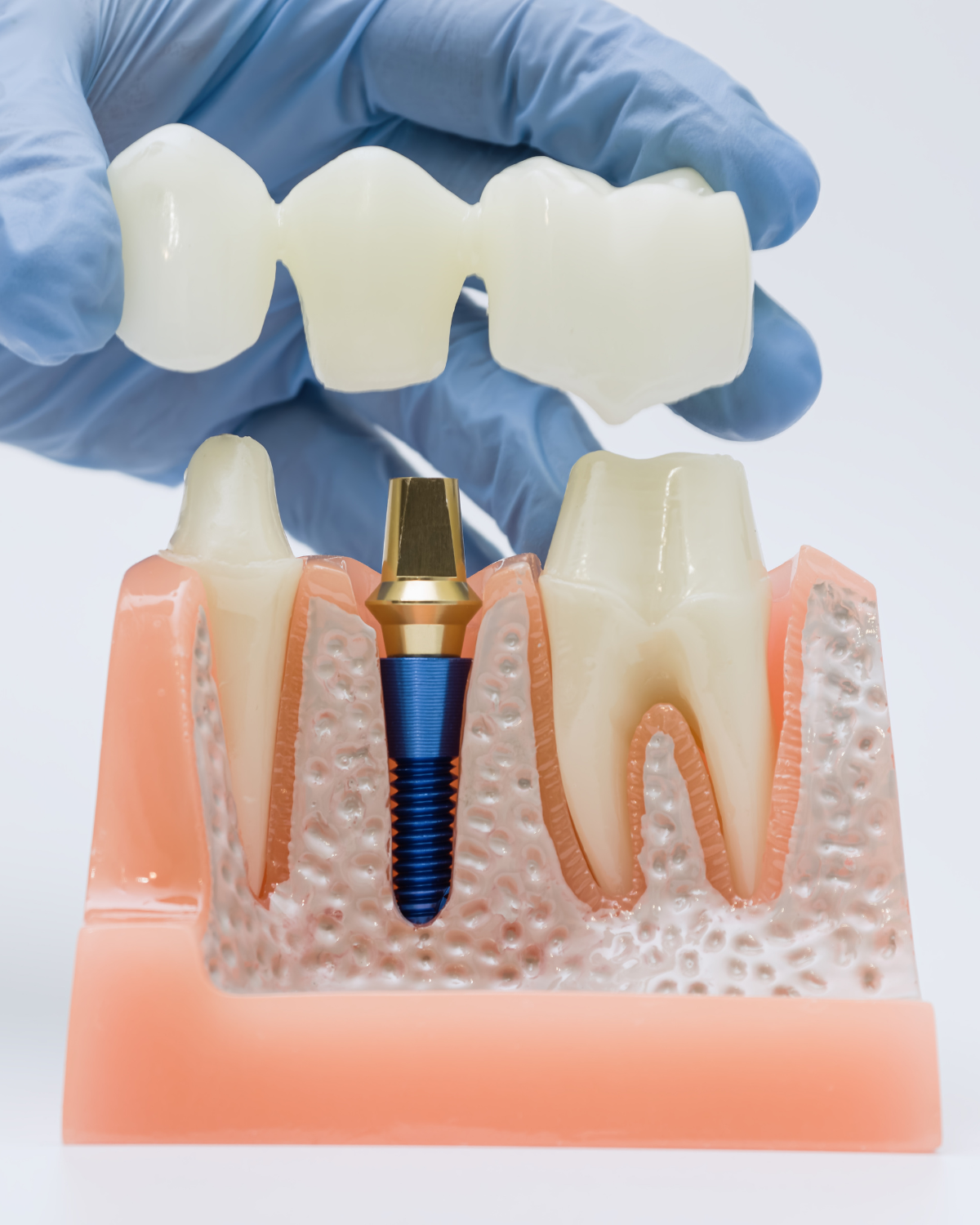
When a dental implant has fully integrated with the jawbone, a crown is attached on top via an abutment connector. The crown restores the visible tooth, and the implant acts as the root.
Fibonacci Smile places implant crowns as part of the complete implant restoration process. Dr. Milner designs the implant crown using CEREC in many cases, fabricating it to match the shade, shape, and size of the surrounding teeth. Implant crowns are placed only after confirming that osseointegration is complete, a process that typically takes three to six months after implant placement.
For patients undergoing the full implant process, the implant placement consultation and the crown fabrication are both managed at Fibonacci Smile by Dr. Milner. You do not need to visit separate specialists for different stages of the treatment. Read more on the dental implants page and the tooth replacement page.
Why Patients in Wenatchee Choose Fibonacci Smile for Crowns
AACD Accreditation: Aesthetics Applied to Every Restoration
Most dentists who place crowns focus on function. Dr. Milner applies the same aesthetic standards to crowns that he applies to veneers. AACD Accreditation requires independent clinical evaluation of cosmetic cases, including cases involving crown restorations. The shade matching, gum margin contouring, and surface texture of a crown at Fibonacci Smile reflect 30 years of training that goes beyond standard dental school education.
Same-Day Convenience with CEREC
For patients with busy schedules in the Wenatchee Valley, the difference between one appointment and two matters. CEREC technology at Fibonacci Smile means the tooth is prepared, the crown is designed, milled, fitted, and bonded in a single visit in most cases. No temporary crown. No second time off work. No risk of the temporary coming loose while waiting for the lab.
Digital Precision from the Start
The digital intraoral scan that begins every CEREC crown procedure at Fibonacci Smile captures a more accurate model of your tooth than a physical impression. That accuracy carries through to the design and fit of the final crown. Dr. Milner designs the crown directly, rather than sending instructions to a laboratory and hoping the interpretation is correct.
The Wand: Comfortable Anaesthesia
Crown preparation requires anaesthesia. Fibonacci Smile uses The Wand, a computer-controlled anaesthetic delivery system that administers local anaesthetic at a slow, controlled pressure. Most patients find the injection experience significantly more comfortable than a traditional syringe. Patients who have avoided necessary crown work because of needle anxiety should ask about The Wand when they call.
30 Years in the Wenatchee Valley
Dr. Milner has been in practice here since 1994. When you get a crown at Fibonacci Smile, the dentist who placed it will still be here in 10 years if an issue arises. That continuity of care is harder to find than it should be.
How Much Does a Porcelain Crown Cost in Wenatchee, WA?
Based on 2025-2026 data from published national and Washington State dental sources, porcelain and zirconia crowns typically range from $1,000 to $1,900 per tooth in mid-market Washington State practices. CEREC same-day crowns fall in the same range, typically $1,200 to $1,900, reflecting the technology investment and design skill involved.
The specific cost of your crown depends on the tooth location, the material selected, and whether any preparatory treatment such as a build-up, post, or root canal is needed beforehand. Fibonacci Smile provides an itemised cost estimate before any treatment begins.
Does Insurance Cover Dental Crowns?
Most dental insurance plans classify crowns as a major restorative procedure and cover approximately 50 percent of the cost after the deductible is met, subject to the plan’s annual maximum, typically $1,000 to $1,500 per year. Some plans have waiting periods for major restorative work, particularly for new members. The billing code used for a crown is the same whether it is a traditional lab crown or a CEREC crown, so same-day technology does not affect coverage.
Fibonacci Smile accepts insurance as a courtesy, files claims on your behalf, and collects an estimated co-pay at the time of service. Call your insurer before your appointment to confirm your crown coverage and any waiting period that may apply.
Financing
CareCredit financing is available at Fibonacci Smile. Patients paying in full by cash or check receive a 5 percent discount. The Fibonacci Smile Subscription Club provides in-house membership benefits for patients without dental insurance. Full details are on the insurance and financing page.
Frequently Asked Questions About Crowns in Wenatchee, WA
How long does a porcelain crown last?
Porcelain and all-ceramic crowns typically last 10 to 15 years. Zirconia crowns tend to last 15 to 25 years due to their greater fracture resistance. Longevity depends on oral hygiene habits, whether you grind your teeth, the bite forces on the crowned tooth, and the quality of the materials and placement. Dr. Milner reviews long-term care at the time of crown placement. CEREC crowns at Fibonacci Smile have shown survival rates comparable to laboratory-fabricated crowns in published clinical studies.
Does getting a crown hurt?
Crown preparation is performed under local anaesthesia. Fibonacci Smile uses The Wand anaesthetic system, which delivers anaesthesia more gradually and comfortably than a traditional syringe injection. After the appointment, mild sensitivity around the prepared tooth is normal for a few days. Over-the-counter pain relief is typically sufficient. If you experience sharp pain to pressure or biting after the crown is placed, call Dr. Milner — the bite may need minor adjustment.
Why do I need a crown after a root canal?
Root canal therapy removes the living pulp from inside the tooth, leaving the tooth structurally intact but more brittle. A molar without a crown after root canal treatment is at significantly elevated risk of vertical fracture under normal chewing forces. A fractured molar after root canal often cannot be saved and requires extraction. Placing a crown protects the tooth and preserves your investment in the root canal procedure.
Can a crown be done in one visit?
Yes, at Fibonacci Smile. CEREC technology allows Dr. Milner to prepare the tooth, digitally scan it, design the crown on-screen, mill it in-office from ceramic, and bond it permanently in a single appointment. Most appointments take two to three hours. Not every crown case is appropriate for same-day fabrication; Dr. Milner will confirm eligibility at your consultation.
What is the difference between a crown and a cap?
Crown and cap refer to the same restoration. A cap is an older common term. Both describe a tooth-shaped covering that fits over the entire visible surface of a tooth from the biting edge to the gumline. The clinical term is crown.
How do I care for a crown?
Brush twice daily with a non-abrasive toothpaste and floss around the crown as you would a natural tooth. The crown itself cannot decay, but the tooth underneath can develop decay at the margin where the crown meets the gum. Regular professional cleanings at Fibonacci Smile keep that margin clean and allow Dr. Milner to monitor the crown’s condition over time. If you grind your teeth, ask about a night guard to protect both your crowns and natural teeth from excessive wear.
What if my crown falls out or breaks?
If your crown falls out intact, contact Fibonacci Smile as soon as possible. Keep the crown in milk or saliva. In many cases the crown can be re-cemented if the tooth beneath is intact. If the crown has broken, a replacement will need to be fabricated. Fibonacci Smile’s CEREC system allows same-day fabrication of a replacement crown in many cases. If the tooth beneath the crown has fractured as well, Dr. Milner will assess what treatment is appropriate. Call (509) 665-0300 and describe the situation.
Is a CEREC crown as good as a lab crown?
In most cases, yes. A study published in the Operative Dentistry Journal found survival rates of 94.7 percent at five years and 85.7 percent at ten years for CEREC crowns, which is comparable to published data for laboratory-fabricated ceramic crowns. The quality of a CEREC crown depends substantially on the dentist’s training and experience with the system. Dr. Milner has used CEREC technology for decades and designs every crown directly rather than delegating the design process.
Can CEREC crowns be used for implants?
Yes. CEREC can fabricate the crown portion that sits atop an implant in most standard implant cases. Dr. Milner confirms eligibility at the restorative phase of your implant treatment. Complex cases involving unusual abutment geometries or full-arch reconstructions may require laboratory fabrication for the best result.
Schedule Your Crown Appointment in Wenatchee
Whether you have a tooth that has needed a crown for a while and you have been putting it off, or you are at the tail end of a root canal and need the crown placed before the tooth fractures, call Fibonacci Smile at (509) 665-0300. Dr. Milner will assess the tooth, give you a clear treatment plan, and in most cases complete your crown in a single appointment using CEREC.
We are at 1 Fifth Street, Suite 100 in downtown Wenatchee. Hours rotate weekly, so call ahead or check the contact page to confirm the current schedule. We see patients from across the Wenatchee Valley including East Wenatchee, Cashmere, Leavenworth, and Chelan.