
Invisalign Clear Aligners in Wenatchee, WA
Most people think of braces as something teenagers deal with. But a significant number of adults in the Wenatchee Valley decide, often for the first time, that they want straighter teeth and a better-aligned bite. Invisalign makes that more practical than it used to be. The aligners are clear, removable, and designed to fit around a working adult’s schedule without the aesthetic and dietary restrictions that come with metal brackets and wires.
Dr. Douglas Milner, DDS offers Invisalign at Fibonacci Smile, located at 1 Fifth Street, Suite 100 in downtown Wenatchee. Dr. Milner holds AACD Accreditation from the American Academy of Cosmetic Dentistry, which means he approaches alignment not just from the perspective of tooth position but from the perspective of how a straight smile integrates with your facial proportions and your overall cosmetic goals. If you have thought about whitening or veneers alongside alignment, that conversation is worth having at your consultation.
Call (509) 665-0300 to schedule an Invisalign consultation at Fibonacci Smile. This page covers how Invisalign works, who is a realistic candidate, what it cannot do, how much it costs in Washington State, and how Fibonacci Smile approaches treatment.
Schedule Your Invisalign Consultation
How Invisalign Works
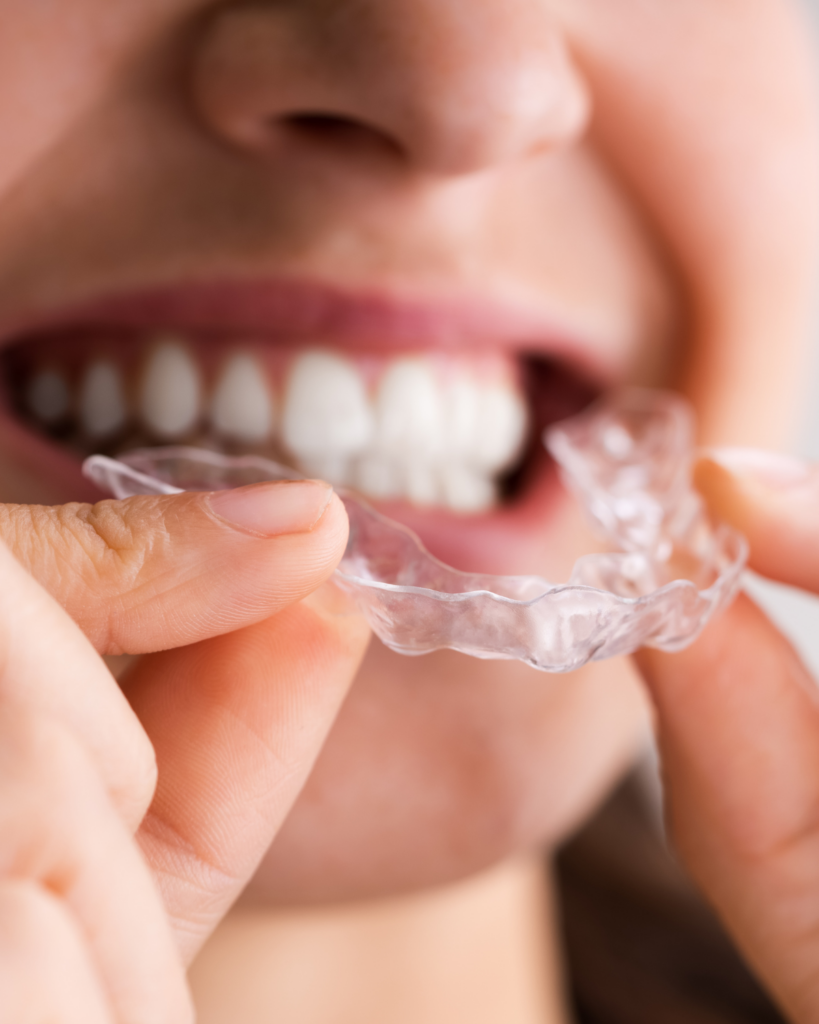
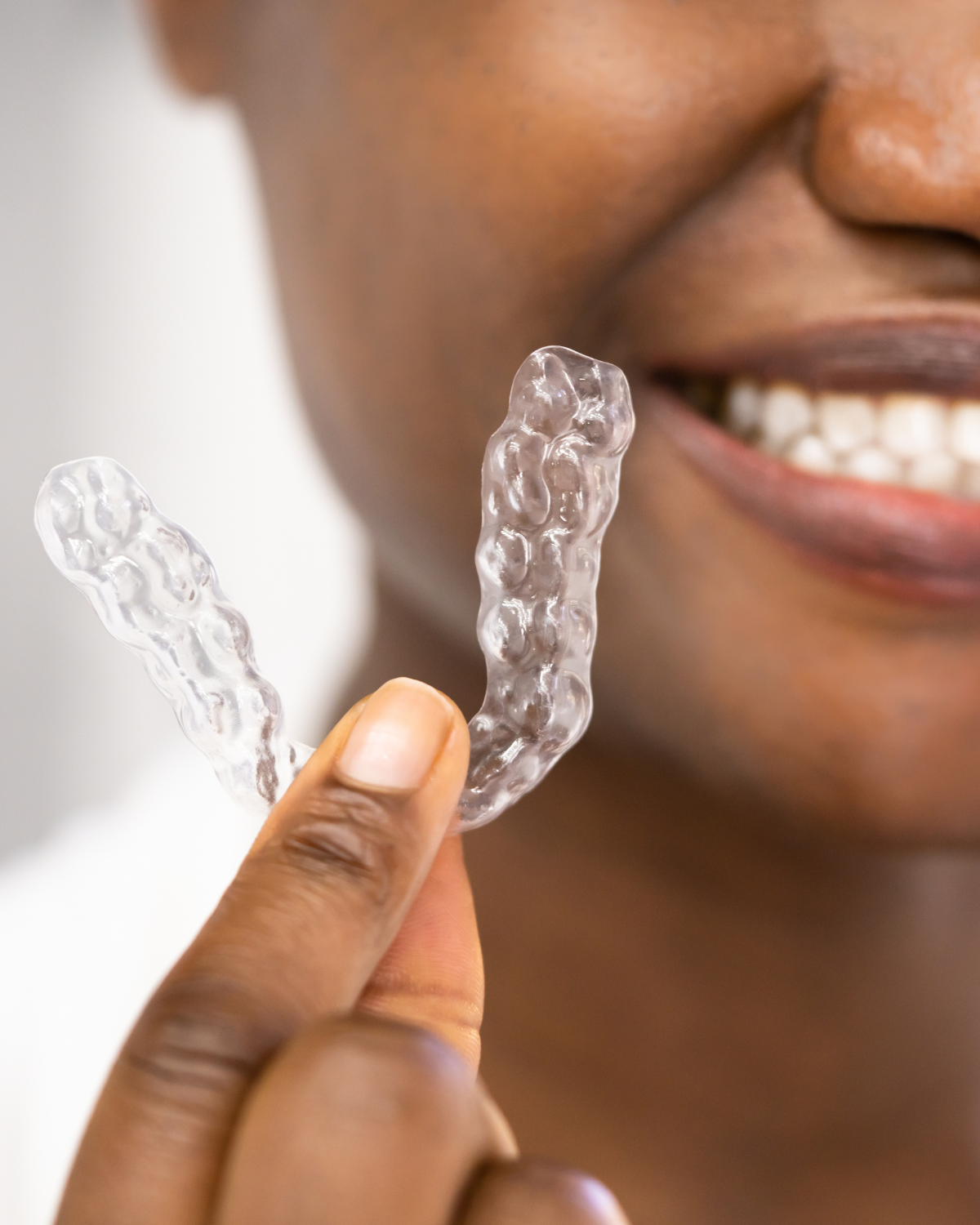
Invisalign uses a series of custom-made, clear plastic trays called aligners. Each tray is fabricated specifically for your teeth based on digital scans taken at your consultation. Every tray in the series moves specific teeth a small amount. You wear each tray for approximately two weeks, then move to the next one. Over the course of several months to two years depending on case complexity, the teeth shift gradually into their target positions.
The trays are made from a smooth medical-grade plastic. There are no wires, no brackets, and no metal of any kind. You remove them to eat, drink anything other than water, brush, and floss. You wear them for 20 to 22 hours per day, meaning they are in place while you sleep and during most of your waking hours.
Dr. Milner reviews your progress at check-in appointments during treatment and dispenses the next set of aligners. The number of check-ins depends on your case. Some patients require attachments, small tooth-coloured dots bonded to specific teeth that give the aligner better purchase to move teeth in particular directions. Dr. Milner will tell you at your consultation whether your case is likely to require attachments.
What Invisalign Can Correct
- Mild to moderate crowding — teeth that overlap or are too close together
- Spacing and gaps between teeth
- Mild overbites — upper front teeth that extend too far over the lower
- Mild underbites — lower teeth that sit in front of the upper when biting
- Crossbites — some upper teeth sitting inside the lower teeth
- Open bites — upper and lower front teeth that do not meet when biting
What Invisalign Cannot Do
Invisalign handles approximately 90 percent of straightening cases, but it is not the right answer for every situation. Severe crowding, complex bite corrections involving significant jaw movement, and some rotation and vertical movements are better addressed by traditional fixed braces. Invisalign also depends on patient compliance. If the trays are not worn consistently, treatment extends or results fall short of the plan.
Invisalign vs Traditional Braces: An Honest Comparison
Wenatchee patients sometimes ask whether Invisalign or traditional braces is the better choice. The answer depends on the case, the patient’s lifestyle, and what they are willing to manage. Here is a side-by-side:
| Factor | Invisalign | Traditional Braces |
|---|---|---|
| Visibility | Nearly invisible clear trays | Visible metal or ceramic brackets and wires |
| Removability | Removable for eating, brushing, and special occasions | Fixed in place for the full treatment duration |
| Dietary restrictions | None — trays come out for meals | Hard, sticky, and crunchy foods restricted throughout treatment |
| Oral hygiene | Easier — brush and floss normally | More difficult — requires special tools around brackets |
| Compliance required | High — must be worn 20 to 22 hours daily without exception | Less dependent on patient behaviour — fixed in place |
| Case complexity | Mild to moderate cases; some complex cases possible | Handles the full range including complex bite and jaw corrections |
| Treatment time (typical) | 6 to 24 months depending on case | 12 to 36 months depending on case |
| Check-in frequency | Every 6 to 12 weeks typically | Every 4 to 8 weeks for adjustments |
| Aesthetics of result | Final result achievable for qualifying cases | Achieves the same corrections with greater case coverage |
| Cost (WA State, full tx) | $3,000 to $8,000 depending on complexity | $3,000 to $7,000 for metal; $3,500 to $7,500 for ceramic |
Dr. Milner will recommend the option that suits your case at your consultation. If traditional braces are a better fit for your alignment goals, he will tell you that directly rather than placing you in Invisalign because it costs more or is easier to sell.
The Invisalign Process at Fibonacci Smile
Step 1: Consultation and Digital Scan
Dr. Milner examines your teeth and bite, takes digital X-rays, and uses digital scanning technology to capture a precise 3D model of your mouth. This scan is sent to Invisalign’s laboratory to generate a ClinCheck treatment simulation, which maps the projected movement of your teeth through every stage of treatment. You can see a visual representation of your expected outcome before your first tray is fabricated.
Step 2: Tray Fabrication and First Fitting
Your custom aligner series is fabricated based on the approved treatment plan. At your fitting appointment, Dr. Milner checks the fit of your first few trays and places any necessary attachments. He walks you through wear and care instructions and answers questions before you leave with your first set.
Step 3: Active Treatment and Check-Ins
You wear each tray for approximately two weeks and return to Fibonacci Smile periodically for Dr. Milner to review your progress and provide your next set of aligners. If your teeth are tracking ahead of schedule, trays can sometimes be changed sooner. If you have fallen behind on wear time, the same tray may need to be worn longer. Consistency is the single biggest factor in keeping your treatment on schedule.
Step 4: Refinements if Needed
Some patients reach the end of their planned series and find that a few teeth have not moved quite as predicted. Invisalign’s refinement process involves a new scan and an additional series of trays to address those final adjustments. Refinements are relatively common and do not represent a failure of treatment. Dr. Milner reviews whether refinements are needed at your final check-in.
Step 5: Retainers and Long-Term Retention
When your active Invisalign treatment ends, your teeth will attempt to drift back toward their original positions. This is not unique to Invisalign, it happens after all orthodontic treatment. Retainers hold the result in place. Dr. Milner provides retainer guidance at your completion appointment. Most patients wear retainers nightly for the long term to protect their result. Replacement retainers typically cost $200 to $500 each.
Combining Invisalign with Whitening or Veneers
Straightening alone changes the alignment of your teeth. For patients who also want to address colour or shape, Invisalign works well as the first step in a broader cosmetic plan.
Whitening is most effective after Invisalign treatment is complete, when all teeth are in their final positions and trays no longer need to be worn. The custom trays from your Invisalign treatment can sometimes be used for home whitening, or Dr. Milner can make a separate set. We discuss this on the teeth whitening page.
Some patients use Invisalign to align teeth before placing porcelain veneers. Moving teeth into better position first means the veneers can be designed from a better structural starting point, and fewer teeth may need to be treated with veneers to achieve the final result. Dr. Milner plans these sequenced approaches at your initial consultation.
Who Is a Good Candidate for Invisalign in Wenatchee?
Invisalign is available for older teens and adults. The key factors Dr. Milner considers at your consultation are:
- Mild to moderate misalignment — the more complex the case, the more likely traditional braces are the better path
- Healthy teeth and gums — decay and gum disease need to be addressed before any orthodontic treatment begins
- Willingness and ability to wear trays 20 to 22 hours per day without exception — patients who are not confident they can maintain compliance are better candidates for fixed braces
- No significant jaw problems that would require skeletal correction beyond tooth movement
Teenagers are Invisalign candidates if they can demonstrate the discipline to wear trays consistently. Invisalign Teen has built-in compliance indicators on each tray. Dr. Milner assesses this honestly at the consultation rather than assuming every teenager is a good fit.
How Much Does Invisalign Cost in Wenatchee, WA?
Invisalign costs in Washington State depend on case complexity and the number of aligners required. Based on data from multiple Washington and national sources verified in May 2026, here is what patients typically pay:
| Treatment Type | Approx. WA State Cost | Typical Timeline | Best For |
|---|---|---|---|
| Invisalign Lite / Express | $2,000 to $3,500 | 3 to 6 months | Minor crowding, small gaps, minor relapses from previous braces |
| Invisalign Moderate | $3,500 to $6,000 | 6 to 12 months | Mild to moderate crowding, spacing, or bite issues |
| Invisalign Comprehensive (Full) | $5,000 to $8,000 | 12 to 24 months | More complex cases with significant crowding, bite correction, or multiple movements |
| Invisalign Teen | $3,500 to $7,000 | 12 to 18 months typically | Older teens with appropriate compliance commitment |
Wenatchee is not a Seattle or Bellevue market. Urban practices in high-cost areas tend to price toward the top of these ranges. Dr. Milner will give you an itemised cost breakdown at your consultation once the case complexity is assessed.
Does Insurance Cover Invisalign?
Many dental insurance plans that include orthodontic benefits cover Invisalign the same way they cover traditional braces, because Invisalign is categorised as an orthodontic treatment rather than a cosmetic one. Typical insurance orthodontic benefits range from $1,000 to $3,000 toward treatment. Some plans cover children’s orthodontics but not adult treatment, so checking your specific plan before your consultation is worth doing. Fibonacci Smile files insurance on your behalf and confirms your coverage before treatment begins.
Financing and Membership
CareCredit financing is available at Fibonacci Smile, allowing you to spread the cost of Invisalign into manageable monthly payments. Patients paying in full by cash or check receive a 5 percent discount. The Fibonacci Smile Subscription Club provides in-house membership benefits for patients without dental insurance. Ask the front desk for current membership details, or read more on the insurance and financing page.
Why Choose Fibonacci Smile for Invisalign in Wenatchee?
Alignment Planned with the Final Smile in Mind
Dr. Milner’s AACD Accreditation means his training goes beyond tooth mechanics. When he plans an Invisalign case, he is thinking about how the aligned teeth will look in the context of your face, your bite, and any subsequent cosmetic work you might want. That perspective makes a difference in the outcome, particularly for patients who are combining alignment with whitening or veneers.
3D Digital Treatment Planning
Every Invisalign case at Fibonacci Smile begins with a digital scan rather than a physical impression. The 3D model is more accurate, more comfortable, and allows Dr. Milner and Invisalign’s laboratory to simulate your treatment progression digitally before a single tray is made. You can see a projected view of your expected result at your consultation appointment.
Honest Candidacy Assessment
Dr. Milner will tell you clearly at your consultation if Invisalign is not the right tool for your alignment goals. Some cases need traditional fixed braces for reliable results. Others are straightforward Invisalign cases. He will not place you in Invisalign if he believes braces would give you a better outcome.
Wenatchee Valley Practice Since 1994
Dr. Milner has been in private practice in the Wenatchee Valley for over 30 years. Patients from Cashmere, Leavenworth, Chelan, East Wenatchee, and across North Central Washington choose Fibonacci Smile for alignment work because of that history and Dr. Milner’s consistent results. You can see completed cosmetic and alignment cases in the Smile Gallery.
Frequently Asked Questions About Invisalign in Wenatchee
How long does Invisalign take?
Treatment time depends entirely on case complexity. Simple cases of minor crowding or small gaps can complete in three to six months with Invisalign Lite or Express. Moderate cases typically take six to twelve months. Complex cases can take eighteen to twenty-four months. Dr. Milner will give you a projected timeline at your consultation after reviewing your digital scan and treatment plan simulation.
Is Invisalign painful?
Most patients feel pressure and mild soreness for one to three days each time they switch to a new tray. This is the aligner doing its job, applying gentle force to move teeth. Over-the-counter pain relief manages this for most people. Invisalign does not carry the risk of wire poking or bracket rubbing that traditional braces do. Most patients find Invisalign more comfortable overall.
How often do I need to come in during treatment?
Check-in frequency at Fibonacci Smile depends on your case. Most Invisalign patients come in every six to twelve weeks. These appointments allow Dr. Milner to confirm your teeth are tracking as planned and to provide your next set of aligners. If an issue arises between appointments, the team is reachable by phone.
What happens if I lose or damage an aligner?
Contact Fibonacci Smile as soon as possible. In most cases, Dr. Milner will advise you to move to the next tray in the series or go back to the previous one temporarily while a replacement is arranged. Replacement aligners can be ordered from Invisalign. The cost of replacements depends on the circumstances and your treatment agreement. Keeping your previous tray when you move to a new one is good practice as a backup.
Can I drink coffee with Invisalign in?
You should remove aligners before consuming anything other than plain water. Hot liquids can warp the plastic. Drinks with colour, including coffee, tea, and red wine, will stain the trays if worn during consumption. The practical rule is simple: anything other than water means the trays come out first.
Does Invisalign work for adults?
Yes. Adults make up a significant proportion of Invisalign patients, and many find it the more practical option precisely because of their professional and social lives. The trays are nearly invisible in most lighting and social settings, and the ability to remove them for meals and important occasions makes the treatment easier to integrate into an adult routine. Dr. Milner treats adults and older teens at Fibonacci Smile and has done so throughout his 30-plus years in the valley.
What happens after Invisalign is done?
When your active aligner series is complete, retainers take over. Teeth will attempt to drift without retention. Dr. Milner provides retainer guidance at your final check-in. Most patients wear retainers nightly long term to hold their result. Fixed (bonded) retainers on the back of the front teeth are another option and are worth discussing if you are concerned about retainer compliance.
Is Invisalign covered by dental insurance?
Many plans with orthodontic benefits cover Invisalign the same as traditional braces, since both are classified as orthodontic treatment. Typical coverage is $1,000 to $3,000. Adult orthodontic coverage varies widely by plan — some plans cover adults fully, others only up to age 18 or 19. Fibonacci Smile verifies your coverage before treatment begins and files all insurance paperwork on your behalf.
Schedule Your Invisalign Consultation in Wenatchee
Whether you have wanted straighter teeth for years and kept putting it off, or you are just starting to think about what alignment treatment might look like for your situation, a consultation at Fibonacci Smile is the straightforward next step. Dr. Milner will scan your teeth, show you a digital preview of treatment, and give you an honest assessment of whether Invisalign is the right path or whether something else would serve you better.
Call us at (509) 665-0300 Our hours rotate weekly — call ahead or check the contact page for the current schedule. We serve patients from Wenatchee, East Wenatchee, Cashmere, Leavenworth, Chelan, and across the Wenatchee Valley.
Browse the Smile Gallery to see cosmetic and restorative results, or read about Dr. Milner’s background and credentials on the meet the doctors page.