
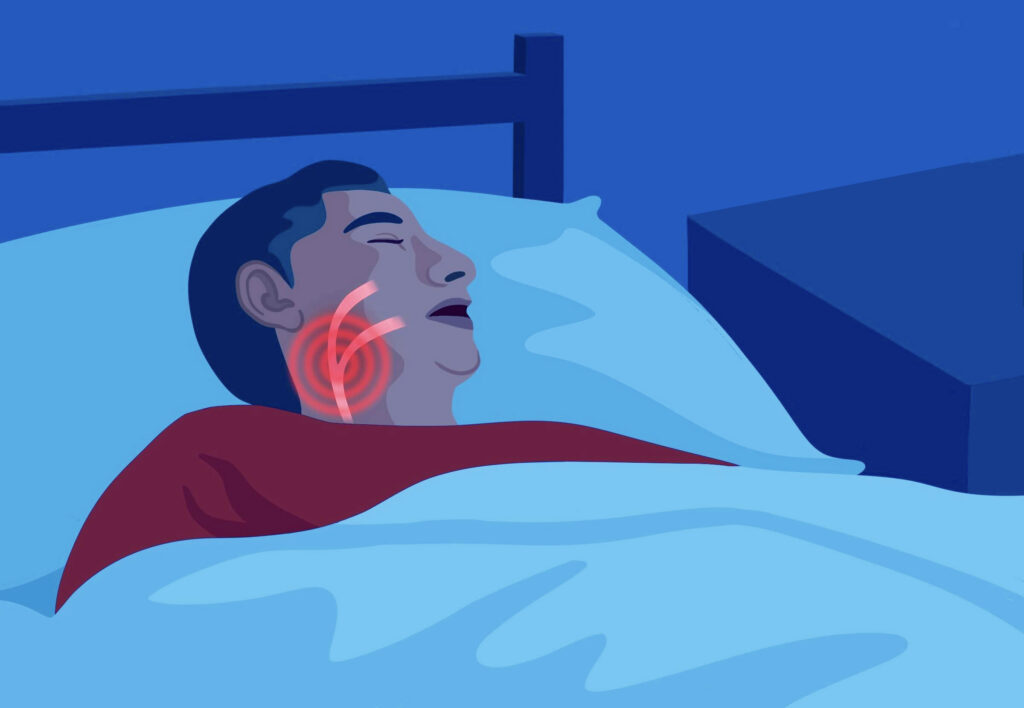
If you snore loudly, wake up tired, or a partner has noticed you stop breathing at night, sleep apnea may be the reason. You might not think of your dentist first. Yet a dentist is often the person who spots the early signs.
Here is the short version. Sleep apnea is a medical condition. A physician diagnoses it with a sleep study, and a dentist does not. What a dentist can do is screen for warning signs and refer you for testing. Once a diagnosis exists, a dentist can treat sleep apnea with a custom oral appliance that keeps your airway open at night.
At Fibonacci Smile in Wenatchee, we check for airway and bite signs at routine visits. We offer treatment once a physician has made a diagnosis. Dr. Douglas Milner, DDS has cared for Wenatchee Valley patients since 1994. We work alongside your doctor, so your sleep is treated as part of your whole health.
What to know if you snore or wake up tired
-
Sleep apnea is a medical condition. A physician diagnoses it with a sleep study, not a dentist.
-
A sleep study grades severity by pauses per hour. Mild is 5 to 15, moderate is 15 to 30, severe is over 30.
-
Most people see a dentist about twice a year. A dentist often spots the warning signs first.
-
An oral appliance holds the lower jaw forward to keep the airway open during sleep.
-
If you snore or wake up tired, ask your doctor about a sleep study.
What is obstructive sleep apnea?
Obstructive sleep apnea is a condition where the airway keeps collapsing during sleep. Soft tissue at the back of the throat relaxes and blocks airflow. Breathing then pauses again and again through the night. Each pause pulls you out of deep sleep, even if you never fully wake up. The result is poor rest and, over time, added strain on your health.
Common signs are easy to miss. Loud snoring is the one most people notice. Others include gasping at night, waking up tired after a full night in bed, morning headaches, and daytime sleepiness. A bed partner often notices the pauses before you do.
Untreated sleep apnea is more than a sleep problem. The American Academy of Sleep Medicine links untreated apnea to daytime fatigue, high blood pressure, and added strain on the heart. That is why testing and treatment matter. Snoring can feel like a minor nuisance, but the condition behind it is not minor.
Why is your dentist often the first to notice?
Most people see a dentist about twice a year. That is often more regularly than they see a physician. During a routine exam, we look closely at your teeth, jaw, tongue, and the back of your throat. Several of those findings can point toward a sleep or airway problem.
Signs we watch for include worn or flattened teeth, a scalloped edge along the tongue, a crowded airway, and dry mouth. Teeth grinding and sleep-disordered breathing often show up together. So a grinding habit is worth a closer look, not just a new night guard.
None of these findings diagnose sleep apnea on their own. What they do is raise the question. When we see them, we talk with you about your sleep. Then we point you toward a physician for proper testing. If you already suspect a problem, tell us at your next cleaning. A short conversation during a routine visit is often what gets the testing started.
How is sleep apnea diagnosed?
Sleep apnea is diagnosed by a physician, not a dentist. The diagnosis rests on a sleep study. That study can be done in a sleep lab, or in many cases at home with a portable monitor. It measures how often your breathing pauses and how far your oxygen level drops.
Those numbers set the severity. The American Academy of Sleep Medicine grades sleep apnea by events per hour. Mild is 5 to 15, moderate is 15 to 30, and severe is more than 30. Severity guides which treatment fits best, so the sleep study always comes first.
This is the step people most want to skip. It is also the one that matters most. Treating suspected apnea without a diagnosis is not safe. A dentist screens and refers. A physician tests and diagnoses. A home sleep test is often simpler and less costly than a night in a lab. Your physician decides which test you need, based on your symptoms and history.
How a dentist treats sleep apnea
Once a physician has diagnosed sleep apnea, a dentist can treat it with oral appliance therapy. An oral appliance is a custom device, a little like a sports mouthguard. You wear it only while you sleep. It holds your lower jaw slightly forward, which keeps the tongue and soft tissue from collapsing into the airway.
The device is custom-made from scans or impressions of your teeth. It is also titratable, which means we adjust how far it moves your jaw. We increase that advancement slowly over several weeks. The goal is to open the airway without straining the jaw. Most patients get used to the device within a few weeks. Early soreness in the jaw or teeth is common at first, and it usually eases as you adjust.
One honest point matters here. An oral appliance treats sleep apnea, but it does not cure it. The American Academy of Dental Sleep Medicine is clear that a dentist should never promise a cure. You still have apnea, so the device helps only on the nights you wear it. A follow-up sleep study often confirms the appliance is doing its job.
Oral appliance and CPAP, compared
Many people first hear about CPAP. It is a bedside machine that pushes steady air through a mask to hold the airway open. CPAP works well and is the first-line treatment for severe sleep apnea. The catch is comfort. Some people cannot tolerate the mask, the hose, or the noise, so the machine ends up unused.
An oral appliance is the main alternative. The American Academy of Sleep Medicine recommends oral appliance therapy for adults with mild to moderate sleep apnea. It also recommends it for people with more severe apnea who cannot tolerate CPAP. The best choice depends on your diagnosis, and your physician helps make that call.
| Feature | Oral appliance | CPAP |
|---|---|---|
| What you wear | A custom device over your teeth | A mask connected to a hose and machine |
| How it works | Holds the lower jaw forward | Pushes pressurized air into the airway |
| Best suited for | Mild to moderate apnea, or CPAP intolerance | All levels, including severe apnea |
| Noise and power | Silent, no power needed | Some noise, needs electricity |
| Travel | Fits in a pocket case | Machine, hose, and mask to pack |
A treatment only helps when you use it. For some people, an appliance worn every night does more good than a machine left in the closet. Some people even use both, an appliance when they travel and CPAP at home. Comfort is worth weighing next to raw effectiveness.
Who is a good candidate for an oral appliance?
An oral appliance suits some patients far better than others. Candidacy is a clinical decision, and we make it with your physician. It rests on your sleep study, your jaw health, and the state of your teeth. We also check that your teeth and gums can anchor the device, since a loose fit cannot hold the jaw where it needs to be.
An oral appliance is often a good fit if you:
-
have mild to moderate obstructive sleep apnea
-
have tried CPAP and cannot use it comfortably every night
-
have enough healthy teeth to hold the device in place
-
do not have severe jaw-joint problems, since the device adds load to the joint
If your apnea is severe, CPAP is usually the better starting point. We will tell you plainly when an appliance is not the right tool. Fitting one anyway would not serve you.
What to do if you think you have sleep apnea in Wenatchee
If you recognize these signs in yourself, start with your doctor. Ask about a sleep study. A diagnosis is the first step, and it opens the door to every treatment option. If testing confirms sleep apnea and an appliance is appropriate, we can take it from there.
At Fibonacci Smile, we provide sleep apnea treatment with custom oral appliances. We coordinate with the physician managing your care. We handle the fitting, the adjustments over the first few weeks, and the follow-up visits that keep the device comfortable. Oral appliances are often billed through medical insurance rather than dental, so we help you sort out coverage before treatment begins.
Your sleep affects far more than how you feel in the morning. Treating it well is worth the effort, and you do not have to work it out alone.
Talk to us about your sleep in Wenatchee
Better sleep can start with one conversation. If you snore, wake up tired, or already have a diagnosis and cannot tolerate CPAP, an oral appliance may be worth exploring.
Call Fibonacci Smile at (509) 665-0300 to schedule a consultation with you Wenatchee Dentist. We will review your history, look at your airway and bite, and work with your physician on a plan that fits your health and your sleep.