
Tooth Replacement in Wenatchee, WA
Losing a tooth changes more than how your smile looks. It changes how you chew, how your remaining teeth sit in your mouth, and over time, the shape of your jaw. Dr. Douglas Milner, DDS has been helping patients in the Wenatchee Valley replace missing teeth since 1994. He has done it with implants, with bridges, with full and partial dentures, and with combinations of all three depending on what each patient needs.
This page is an honest overview of the three main tooth replacement options available at Fibonacci Smile, how they compare across the factors that actually matter to patients, and how to think about which one fits your specific situation. If you already know what you want, call (509) 665-0300 and schedule a consultation. If you are still working through the options, read on.
Schedule a Tooth Replacement Consultation
Why a Missing Tooth Cannot Be Left Untreated
Most patients know a gap affects their smile. What many do not know is what happens beneath the surface. When a tooth root is no longer present in the jawbone, the bone in that area stops receiving the stimulation it needs to maintain its density. Within the first year after tooth loss, measurable bone resorption begins. Over time, that bone loss changes the shape of the jaw, causes neighboring teeth to drift and tilt toward the gap, can lead to bite misalignment, and progressively makes future restoration more complex and expensive.
The longer a gap is left unfilled, the fewer options remain available and the more preparatory work, such as bone grafting, may be needed before any replacement can be placed. Acting sooner preserves the most options and the most bone.
The Three Main Tooth Replacement Options at Fibonacci Smile
Option 1: Dental Implants
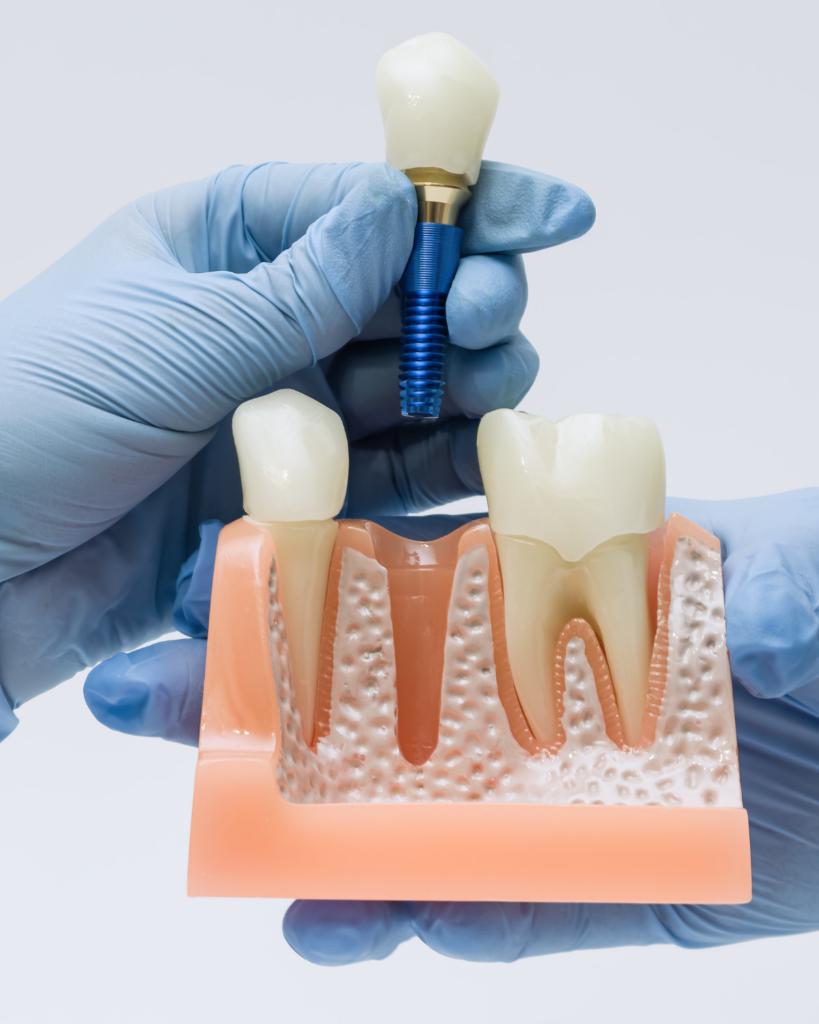
A dental implant is a titanium post placed into the jawbone to replace the missing tooth root. After a healing period during which the post fuses with the bone (osseointegration), a custom crown, bridge, or denture is attached on top. The result is a fixed, stable restoration that looks, feels, and functions like a natural tooth.
Implants do not rely on neighbouring teeth for support. They preserve bone density. The crown on top can often be fabricated using Fibonacci Smile’s CEREC system in a single visit once the implant has integrated. They are the most durable option available, with the post itself designed to last a lifetime and the crown lasting 10 to 20 years with proper care.
The tradeoffs: implants require a surgical procedure, a healing period of several months, and a higher upfront cost than bridges or dentures. Not every patient has sufficient bone density without preparatory grafting.
Option 2: Porcelain Bridges
A dental bridge spans a gap by anchoring an artificial tooth (called a pontic) to crowns placed over the teeth on either side of the gap. It is a fixed, non-removable restoration that restores chewing function and appearance without surgery.
Bridges can be completed in fewer appointments than implants and cost less upfront. The tradeoff is that the neighbouring teeth must be filed down to accommodate the anchoring crowns, permanently altering teeth that may otherwise be healthy. Bridges do not prevent the bone resorption beneath the gap. They typically last 10 to 15 years before needing replacement. Fibonacci Smile uses CEREC technology to design and mill bridge crowns in-office when appropriate.
Option 3: Full and Partial Dentures
Dental Implants vs Bridges vs Dentures: A Complete Comparison
Choosing a tooth replacement option involves balancing upfront cost, timeline, invasiveness, and long-term outcomes. This table covers the 10 factors that matter most:
| Factor | Dental Implant | Porcelain Bridge | Full/Partial Denture |
|---|---|---|---|
| How it works | Titanium post in jawbone topped with a crown | Artificial tooth anchored to crowns on adjacent teeth | Removable prosthetic resting on gums or clipping to remaining teeth |
| Surgery required | Yes — implant placement is a minor surgical procedure | No — adjacent teeth prepared for crowns | No — impressions and fitting only |
| Adjacent teeth affected | No — implant stands alone | Yes — neighbouring teeth filed down for crown anchors | Partial dentures clip to remaining teeth; some impact |
| Bone loss prevention | Yes — implant root stimulates jawbone | No — bone resorption continues beneath the gap | No — bone resorption continues; worsens over time with full dentures |
| Longevity (post/base) | 20+ years to lifetime (post); 10-20 years (crown) | 10 to 15 years before replacement typically needed | 5 to 8 years before relining or replacement needed |
| Typical WA State cost | $3,000 to $6,000 per tooth (post, abutment, crown) | $2,500 to $5,500 for 3-unit bridge | $1,000 to $3,500 (partial); $1,500 to $5,000 (full) |
| 20-year cost estimate* | ~$4,500 once (implant lasting 20+ years) | ~$7,500+ (bridge replaced 1-2 times) | ~$9,000+ (denture replaced, relines, adjustments) |
| Look and feel | Most natural — fixed and anchored like a real tooth | Fixed and natural-looking; relies on adjacent teeth | Removable; may shift; takes adjustment; less natural feel |
| Treatment timeline | 4 to 12 months (including osseointegration) | 3 to 6 weeks (2 to 3 appointments) | 3 to 8 weeks (2 to 4 appointments) |
| Best suited for | Most adults with sufficient bone or who can graft; long-term preferred solution | Patients who cannot have surgery; need a faster/lower-cost fixed option | Multiple missing teeth; patients needing lowest upfront cost; full arch loss |
*20-year cost estimates are approximations based on published Washington State cost data and typical replacement intervals. Individual cases vary. These figures are provided for comparison purposes only. Dr. Milner will provide an itemised cost estimate for your specific situation at your consultation.
The Cost-Per-Year Picture: What No One Tells You Upfront
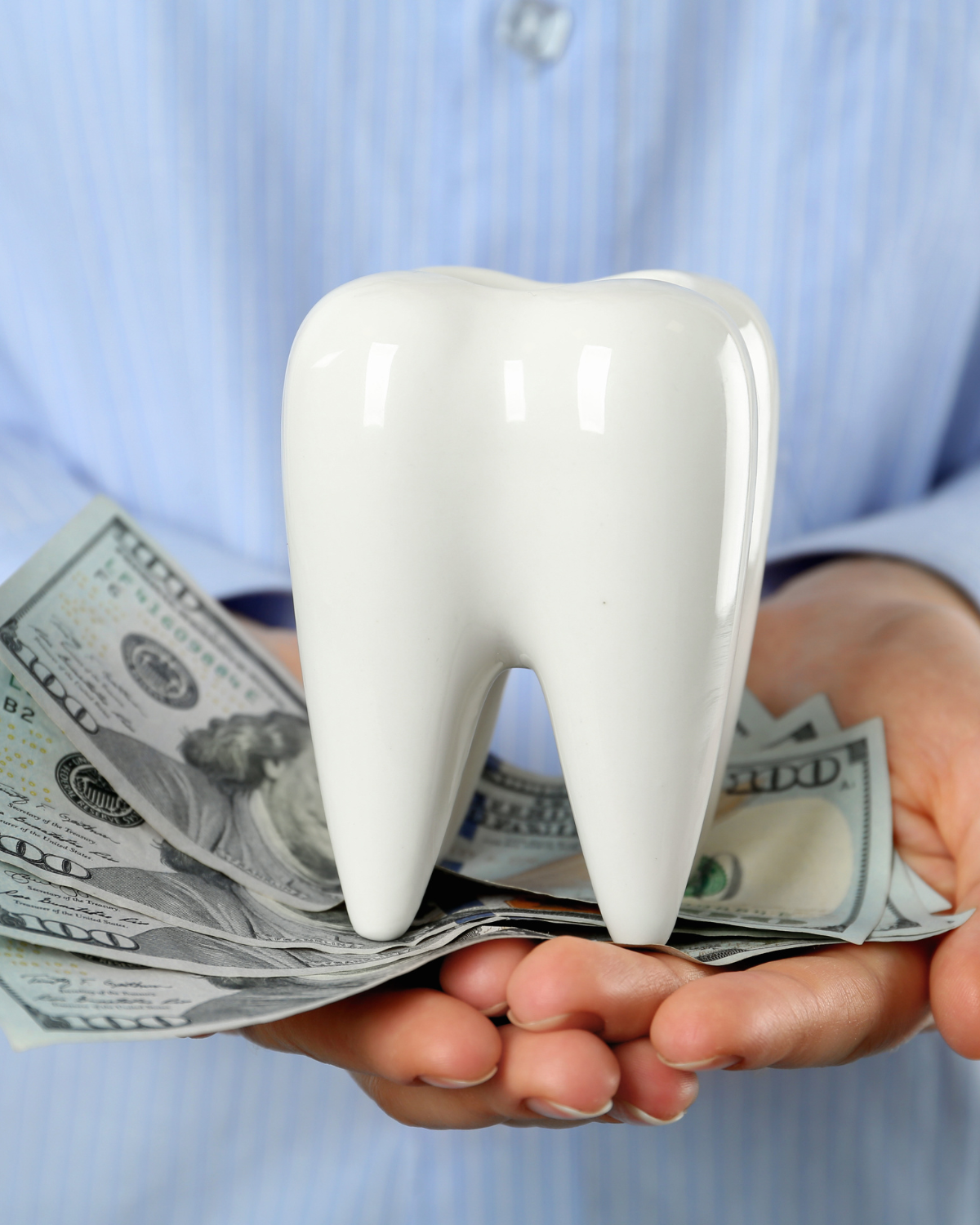
Patients almost always compare tooth replacement options by their upfront price. That is a reasonable starting point, but it is not the full story.
A traditional dental bridge costs $2,500 to $5,500 upfront. Most bridges last 10 to 15 years before they need replacement, and they often require work on the anchor teeth when they fail. A patient who replaces a bridge twice over 30 years may spend $7,500 to $11,000 or more, plus the costs of any complications with the anchor teeth.
A full denture costs $1,500 to $5,000 upfront, but the jawbone continues to resorb beneath it. That changes the fit. Relines are typically needed every one to two years at $300 to $600 each, and full replacement every five to eight years. Over 20 years, a patient may spend more on denture maintenance than on a single well-placed implant.
A dental implant costs $3,000 to $6,000 per tooth upfront. The post is designed to be permanent. The crown may need replacement after 10 to 20 years. For many patients, the 20-year total cost of an implant is equal to or lower than repeated bridge or denture replacements.
Which Tooth Replacement Option Is Right for You?
There is no single right answer. The right option depends on how many teeth are missing, the health of your jawbone and remaining teeth, your budget and timeline, and your long-term goals. Here is a practical guide:
| Your Situation | Option to Explore First |
|---|---|
| Single missing tooth, good bone density, no significant health contraindications | Dental implant — best long-term outcome, preserves bone, no impact on adjacent teeth |
| Single missing tooth, cannot have surgery or need a faster solution | Porcelain bridge — fixed, completed in 2-3 appointments, lower upfront cost |
| Multiple missing teeth in different areas | Combination of implants and/or partial dentures depending on location and bone |
| Multiple adjacent missing teeth | Implant-supported bridge (2 implants supporting 3-5 replacement teeth) or partial denture |
| Full arch missing (top or bottom) | Full denture or implant-supported overdenture for greater stability |
| Significant bone loss at the gap site | Bone grafting followed by implant placement, or bridge/denture while bone is assessed |
| Budget is the primary constraint right now | Denture or bridge first; implant later if circumstances change (existing bone preserved where possible) |
This table is a starting point, not a diagnosis. Dr. Milner reviews your X-rays, examines your bone and gum health, discusses your goals, and maps out a realistic plan with cost and timeline for each viable option before any treatment is recommended.
Why Wenatchee Patients Choose Fibonacci Smile for Tooth Replacement
One Dentist, Complete Tooth Replacement Care
At Fibonacci Smile, Dr. Milner handles the implant placement consultation, monitors the healing phase, and places the final restoration. For bridges and dentures, he manages every stage of treatment. Patients are not referred from one provider to another for different phases of a single treatment. That continuity matters when a restoration spans several months.
3D Digital Planning for Complex Cases
Fibonacci Smile uses digital X-rays and 3D digital mapping to assess bone volume, nerve locations, and sinus proximity before any implant placement. That level of pre-surgical planning supports more accurate implant positioning and reduces the risk of complications. It also allows Dr. Milner to identify when bone grafting is needed before treatment begins, rather than discovering it during surgery.
CEREC In-Office Crown and Bridge Fabrication
When the restoration phase requires a crown or bridge, Fibonacci Smile’s CEREC system allows Dr. Milner to design, mill, and place the restoration in-office, often in a single appointment. No temporary crown. No second visit waiting on a laboratory. For patients who need to complete their tooth replacement with minimal disruption to their schedule, that matters. Read more on the CEREC same-day crowns page.
AACD Accreditation: Restorations Placed with Cosmetic Precision
Dr. Milner’s AACD Accreditation is typically mentioned in the context of veneers and cosmetic work. But it is equally relevant to tooth replacement. When an implant crown, bridge, or partial denture is placed at Fibonacci Smile, it is shade-matched, shaped, and proportioned with the same attention to aesthetics that defines Dr. Milner’s cosmetic work. A functional restoration that looks noticeably different from the surrounding teeth is not an acceptable outcome.
Sedation for Patients Who Need It
Implant placement is a surgical procedure, and some patients are anxious about surgical dental treatment. Fibonacci Smile offers laughing gas, oral sedation, and conscious sedation. The team also provides comfort amenities during longer appointments. You can read more about sedation options on the sedation and comfort page.
30 Years in the Wenatchee Valley
Dr. Milner has been in private practice here since 1994. He grew up in Cashmere. Patients from East Wenatchee, Leavenworth, Chelan, and across North Central Washington choose Fibonacci Smile for tooth replacement because of the consistency of results over many years. A dentist who will still be here in 10 years when your implant crown needs attention is worth factoring into a decision about a long-term restoration.
Cost and Insurance for Tooth Replacement in Wenatchee
Tooth replacement costs in Washington State vary by option, case complexity, and whether preparatory procedures like bone grafting are required. The ranges below are based on published Washington State and national data verified in May 2026 and are provided for orientation only.
| Option | WA State Cost Range | Insurance Coverage | Financing |
|---|---|---|---|
| Single dental implant (post, abutment, crown) | $3,000 to $6,000 | Varies widely. Some plans cover the crown; most do not cover the post. Confirm with your insurer. | CareCredit available. 5% cash/check discount. Subscription Club for uninsured. |
| Porcelain bridge (3-unit) | $2,500 to $5,500 | Most PPO plans cover 50% of major restorative work up to annual maximum ($1,000-$2,000/yr). | CareCredit available. 5% cash/check discount. |
| Partial denture | $1,000 to $3,500 | Most PPO plans provide partial coverage for dentures. Check your specific plan limits. | CareCredit available. Subscription Club for uninsured. |
| Full denture | $1,500 to $5,000 per arch | Similar coverage to partials — confirm annual maximum and waiting period with insurer. | CareCredit available. |
| Bone grafting (if required) | $500 to $3,000 depending on extent | May be covered under dental or medical depending on cause. Confirm with insurer. | CareCredit available. |
Fibonacci Smile accepts insurance as a courtesy, files on your behalf, and provides an itemised cost estimate before any treatment begins. For patients without dental insurance, the Fibonacci Smile Subscription Club provides in-house membership benefits at reduced rates. CareCredit financing is available for any balance. Patients paying in full by cash or check receive a 5 percent discount. Full details are on the insurance and financing page.
Frequently Asked Questions About Tooth Replacement in Wenatchee
What is the best tooth replacement option?
How long does tooth replacement take?
Does it hurt to get a dental implant?
Can I get an implant if I have lost bone where the tooth was?
How long do bridges and dentures last?
Is a bridge or an implant better?
Can I get implants if I already wear dentures?
What if I cannot afford an implant right now?
Talk to Wenatchee's Tooth Replacement Specialist
Dr. Milner has been replacing missing teeth in the Wenatchee Valley for over 30 years. He grew up in Cashmere and chose to practice here. When he gives you a recommendation on implants, bridges, or dentures, it is based on your anatomy, your health, your goals, and what he has seen work for patients in this community over decades, not on which option costs more.
If you have one missing tooth or many, call (509) 665-0300 or email info@fibonaccismile.com to schedule a consultation. Our hours rotate weekly, so call ahead to confirm the current schedule. We serve patients from across the Wenatchee Valley including East Wenatchee, Cashmere, Leavenworth, Chelan, and beyond.